New Indian Express, 19/7/09
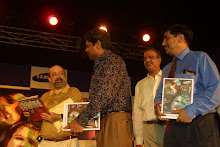
Shadows Across the Playing Field: 60 Years of India-Pakistan Cricket. By Shashi Tharoor and Shaharyar Khan. Roli Books. 189 pages; illustrated; Rs. 295.
By Gulu Ezekiel
Cricket matches between India and Pakistan have been played since the early 1950s and have always had an edge to them, rivaling even international cricket’s oldest series between England and Australia.
The reason for heightened tensions when the two nations meet is of course wrapped up in history, politics and religion.
Former UN diplomat and current Minister of State for External Affairs, Shashi Tharoor and career diplomat and former head of the Pakistan Cricket Board, Shaharyar Khan (cousin of Mansur Ali Khan, aka the Nawab of Pataudi) have been chosen to trace the stormy history of Indo-Pakistan cricket in this book split between their two essays.
Khan’s choice is a logical one. He has an intimate inside view of cricket in Pakistan and was manager of the teams that toured India in 1999 and 2005.
Tharoor’s links are more tenuous. We are told on the inside flap of the book that he has “encyclopaedic knowledge” of Indian cricket which makes it even more surprising that he has committed so many factual errors in his essay.
What is most striking when comparing the two chapters is the number of issues on which the authors hold diametrically opposing views.
This different reading of history also explains why India and Pakistan have been at loggerheads for over six decades. But it is no bad thing in a book—it gives the reader pause for thought and allows him to make his own judgment.
Take for example the cricket tournaments played on religious lines in Bombay and Poona, the Quadrangular starting in 1912-13 and the Pentangular ending in 1945-46.
Tharoor, a self-confessed Nehruvian takes up Mahatma Gandhi’s point of view that the event was a direct assault on the Congress Party’s ideals of secularism.
Khan is convinced that the success of a separate Muslim team bolstered Jinnah’s two-nation theory and therefore was a positive development. He also quotes the players, including top Hindu cricketers of the time that the matches never led to communal disturbances and in fact acted as a harmless outlet for letting off steam.
Then there is the attitude of Pakistanis to the large number of Muslims who have represented India including four captains. (Tharoor omits Iftikhar Ali Khan, the senior Nawab of Pataudi when listing their names).
This has always been a thorn in the flesh of Pakistan according to Tharoor as evinced by Pakistan captain Shoaib Malik’s communally tinged remark at the end of the 2007 World Twenty-20 final in which India beat Pakistan at Johannesburg.
Khan is defensive when comparing Pakistan’s treatment of its minorities with India. The controversial case of Yousuf Youhana who converted from Christianity to become Mohammad Yousuf is another subject on which the two disagree.
To set the record straight, Yousuf did lead Pakistan in a handful of ODIs as stand-in captain when Inzamam-ul-Haq was either injured or serving out a ban.
However, on Inzamam’s retirement when it came to appointing his successor, it was reportedly the legendary Imran Khan who stressed to the PCB that a non-Muslim should never be appointed as full-time captain of the Pakistan Test team.
Khan has placed on record that the frosty ties between the two cricketing nations was thawed when Pakistan visited India in 1999, their first full tour for 12 years. Indian fans who crossed the border for the 2004 tour were bowled over by the hospitality of their hosts. But it was India that set the friendly trend. Indeed, the warmth with which all of India greeted the very first Pakistan team to visit in 1952 is also a matter of record.
Tharoor’s insistence on recording each and every result—Test, ODI, T-20 Internationals and even tour matches against domestic sides— makes one’s head reel with the endless litany of facts and figures, all of which are recorded in any case at the end of the book. In between he makes scathing attacks on the very basis of Pakistan’s founding and the violent turmoil it has witnessed since.
Some of Tharoor’s more caustic comments may come back to haunt him now that he will have to deal directly with Pakistan’s leaders at the diplomatic level. This book was written before his ministerial appointment.
As for the errors in Tharoor’s essay, they are too numerous to list here. It is about time publishers appointed dedicated and knowledgeable cricket fact checkers to go through manuscripts rather than relying on editors and proof readers who have little or no understanding of cricket.
Finally, Khan’s assertions that there were no official Pakistani links to the 26/11 terrorist attacks on Mumbai is unlikely to carry any weight in India. That outrage and the subsequent attack on the Sri Lankan cricket team in Lahore has practically put finis to any hope of further international sporting events on Pakistan soil, including the 2011 World Cup for which it has already been stripped of its joint hosting rights by the ICC.
Wednesday, July 29, 2009

Thursday, June 25, 2009
Pakistan Stun the World
22/6/09
By Gulu Ezekiel
Several myths have been demolished and at least one theory set in stone now that Pakistan have stunned the cricket world by lifting the World T-20 trophy at Lord’s on Sunday.
What has been confirmed is that this is the most unpredictable format of the game and there is no such thing as a pre-tournament or even pre-match favourite.
If India were the shock winners of the inaugural tournament two years back, few before the second edition would have backed Pakistan to win.
In the IPL too, Rajasthan Royals were the dark horses in 2008 and went on to become champions while in 2009 last year’s bottom placed team, Deccan Chargers finished on top.
The biggest myth that has been torn to pieces is that playing in the IPL helps to prepare for international matches.
Coach Gary Kirsten has just been given a gag order by the BCCI not to speak out on the IPL. But he certainly let the cat out of the bag when he stated that the standard in the IPL--after all a domestic tournament--is way below international standard.
The proof of the pudding as the saying goes is in the eating. How else can one account for India with all its players coming straight out of the IPL failing to reach the semifinals, while Pakistan who did not have a single representative emerging as champions?
The terrorist attacks on Pakistan soil meant no one was willing to visit that nation for a sporting event.
Shunned by the sporting world and having their hosts rights stripped for the 2011 World Cup, Pakistan’s players have given a stinging rejoinder and silenced their critics with a stunning display.
The mood in Pakistan is understandably buoyant and Sunday’s victory will perhaps act a morale booster for a nation under siege.
By Gulu Ezekiel
Several myths have been demolished and at least one theory set in stone now that Pakistan have stunned the cricket world by lifting the World T-20 trophy at Lord’s on Sunday.
What has been confirmed is that this is the most unpredictable format of the game and there is no such thing as a pre-tournament or even pre-match favourite.
If India were the shock winners of the inaugural tournament two years back, few before the second edition would have backed Pakistan to win.
In the IPL too, Rajasthan Royals were the dark horses in 2008 and went on to become champions while in 2009 last year’s bottom placed team, Deccan Chargers finished on top.
The biggest myth that has been torn to pieces is that playing in the IPL helps to prepare for international matches.
Coach Gary Kirsten has just been given a gag order by the BCCI not to speak out on the IPL. But he certainly let the cat out of the bag when he stated that the standard in the IPL--after all a domestic tournament--is way below international standard.
The proof of the pudding as the saying goes is in the eating. How else can one account for India with all its players coming straight out of the IPL failing to reach the semifinals, while Pakistan who did not have a single representative emerging as champions?
The terrorist attacks on Pakistan soil meant no one was willing to visit that nation for a sporting event.
Shunned by the sporting world and having their hosts rights stripped for the 2011 World Cup, Pakistan’s players have given a stinging rejoinder and silenced their critics with a stunning display.
The mood in Pakistan is understandably buoyant and Sunday’s victory will perhaps act a morale booster for a nation under siege.
Lanka are Favourites
20/6/09
By Gulu Ezekiel
Barring a major surprise, there seems little doubt that Sri Lanka will emerge champions after Sunday’s final of the World Cup T-20 championship.
Pakistan’s road to the final has seen its ups and downs. But the Lankans are the only team to remain unbeaten till now.
They were placed with Australia and the West Indies in Group C, the so-called ‘group of death’ in the first stage and came through on top.
In the Super 8 stage they comfortably beat New Zealand, Ireland and Pakistan. And their victory over the West Indies at the Oval in Friday’s semifinal was a stroll in the park. That makes it six wins on the trot, a tough feat in 20/20 cricket.
The win over Pakistan by 19 runs at Lord’s last week in the second stage will give them tremendous confidence going into Sunday’s final.
In Tillakaratne Dilshan they have the highest run scorer in the tournament by far and a batman capable of the most eye-popping shots. His dazzling innings 96 not out saw him fall just four runs short of becoming only the second batsman to reach a century in T-20 Internationals.
Till now their bowling attack was the most feared in the tournament due to the ‘Three M’s’—Malinga, Murali and Mendis.
Add to that a fourth, Angelo Mathews who sealed the match on Friday with three wickets in the opening over.
Pakistan’s unpredictability is what makes them so daunting and Lanka know they have a fight on their hands on Sunday.
Shahif Afridi is a one-man demolition job, much like Sanath Jayasuriya. What in the world went wrong with the left-hander on Friday though will remain one of cricket’s big mysteries.
Finally, the all-Asia final will resolve once and for all whether the IPL helped or hindered preparations.
Pakistan, remember had no representation at all in South Africa while there were a whole bunch of Lankans taking part.
By Gulu Ezekiel
Barring a major surprise, there seems little doubt that Sri Lanka will emerge champions after Sunday’s final of the World Cup T-20 championship.
Pakistan’s road to the final has seen its ups and downs. But the Lankans are the only team to remain unbeaten till now.
They were placed with Australia and the West Indies in Group C, the so-called ‘group of death’ in the first stage and came through on top.
In the Super 8 stage they comfortably beat New Zealand, Ireland and Pakistan. And their victory over the West Indies at the Oval in Friday’s semifinal was a stroll in the park. That makes it six wins on the trot, a tough feat in 20/20 cricket.
The win over Pakistan by 19 runs at Lord’s last week in the second stage will give them tremendous confidence going into Sunday’s final.
In Tillakaratne Dilshan they have the highest run scorer in the tournament by far and a batman capable of the most eye-popping shots. His dazzling innings 96 not out saw him fall just four runs short of becoming only the second batsman to reach a century in T-20 Internationals.
Till now their bowling attack was the most feared in the tournament due to the ‘Three M’s’—Malinga, Murali and Mendis.
Add to that a fourth, Angelo Mathews who sealed the match on Friday with three wickets in the opening over.
Pakistan’s unpredictability is what makes them so daunting and Lanka know they have a fight on their hands on Sunday.
Shahif Afridi is a one-man demolition job, much like Sanath Jayasuriya. What in the world went wrong with the left-hander on Friday though will remain one of cricket’s big mysteries.
Finally, the all-Asia final will resolve once and for all whether the IPL helped or hindered preparations.
Pakistan, remember had no representation at all in South Africa while there were a whole bunch of Lankans taking part.
Thursday, June 18, 2009
Kirsten Bells the Cat
16/6/09
By Gulu Ezekiel
The BCCI is acting true to form in attacking coach Gary Kirsten for his frank and unbiased comments on the IPL affecting the Indian team at the T-20 World Cup.
Kirsten is in the best position to know the mental and physical condition of his players and is neither on the payrolls of the IPL nor does he have an axe to grind. His salary after all comes from the BCCI.
If is pretty courageous, some would say foolhardy, of Kirsten therefore to come out with this statement which has blown the lid off the BCCI’s money obsession.
The way the IPL mouthpieces have reacted is predictable as their bread and better depends on the successful running of this domestic corporate-based cricket circus.
The IPL has thus become both a cash cow and a sacred cow as well and any hint of criticism by unbiased observes is immediately pounced upon by officials, ex-players and sadly, many in the media too who are covertly or overtly involved with this money-minting machine.
Hopefully there will be some internal soul searching among the more level-headed officials who would have the common sense to understand that the schedule of the IPL is far too long and taxing for the players.
For some unknown reason, the ICC has scheduled the next World Cup just nine months from now and a similar situation is bound to crop up again.
Kirsten though must be pretty naïve if he thinks that any Indian cricketer will actually ponder the idea of missing the IPL in order to be fit for national duty. Besides, the corporate honchos who pull the strings for their franchises will not tolerate this notion. For them, their company’s image is more important than the nation’s and so after over 130 years of country v. country cricket, we have finally seen a tectonic shift in the loyalties of our players.
It is a sad day but with the BCCI’s priority being simply to line their already stuffed pockets, this scenario was just waiting to happen.
IPL Mouthpieces Cornered
By Gulu Ezekiel
All those paid IPL mouthpieces, both overt and covert, will have a lot to answer for now that defending champions India have been knocked out of the World T-20.
Having been bombarded with propaganda for the last few weeks that India is the best placed team in the tournament as all its players took part in the IPL, one wonders what that bunch will come up with now.
It should be pretty obvious to any impartial observer that the Indian players are carrying and covering injuries as they are playing far too much cricket.
The players had been complaining of burnout pre-IPL as well. But since the first season last year and last month’s edition, the load has increased enormously.
You will never hear a professional cricketer to voice his opinion of overload during the IPL as they are paid well to not only pay but also to keep their mouths shut.
Hardly had the tour of New Zealand finished, when it was time for the IPL this year. And right after that came the World championships.
The sordid saga of Virender Sehwag has already been discussed ad nauseum and Zaheer Khan also said he was lucky to escape with a minor injury after injuring his shoulder in the IPL.
MS Dhoni has been nursing bruised hands for some time now and this showed in England where both his keeping and batting were sub-par.
Since the priority has now switched from international cricket to corporate cricket, we can expect more such injuries and further debacles from the national side.
After all, all the money in the world cannot buy you a successful team as the BCCI has finally discovered.
Coming back to the World Cup, South Africa now appear to be the favourites. If they do lift the cup at Lord’s next week it will be their first major title at the world level since the Wills International Cup tournament at Dhaka in 1998.
Captain Cool Feels the Heat
By Gulu Ezekiel
Two years in the job and the pressures appear to have got to captain MS Dhoni.
It was Sunil Gavaskar who thought up the nickname of ‘Captain Cool’ for Dhoni after watching him guide India to victory in his maiden assignment in the inaugural World Cup 20/20 in South Africa in 2007. And I chose that title for my biography of Dhoni that was released late last year.
But being captain of the Indian cricket team has brought even more stress on the incumbent than ever before with three formats of the game to contend with at the international level.
Added to that are the unique stress levels associated with the IPL where Dhoni captains Chennai Super Kings and one can well understand the burdens he has to carry. Being the wicket-keeper and a leading batsman to boot only makes the task more difficult.
From the time he took charge of the team, Dhoni has always endeared himself to the media with his insouciant airs and tongue in cheek answers.
All that has changed this time around and the way he batted in India’s opening Super 8 match against the West Indies at Lord’s on Friday, it looked like he had taken the cares of the world upon his sturdy shoulders.
Dhoni tried to patch things up with the press and admitted he had changed over the last two years. But the BCCI left the captain holding the baby in the mess over Virender Sehwag’s fitness and it will take a mighty effort now to get his relationship with the media back on an even keel.
This is where the media manager must step in and take some off the heat off the captain. But the Board appears to think that a professional to handle such matters is quite unnecessary. And so it bungles on.
If the defending champions fail to progress from here, Dhoni will cop the blame. That would be a crying shame.
India in Tough Group
By Gulu Ezekiel
Having been placed in the weakest team by rights as defending champions, India now find themselves in the tougher of the two Super 8 groups with their first match against the West Indies on Friday.
The Indians have been clinical without being spectacular in easing past Bangladesh and Ireland in the prelims. But they will face a stern test in taking on the Caribbeans, hosts England and formidable South Africa.
West Indies dealt one of the biggest blow of the tournament when they crushed Australia in their opening match thanks to a spectacular innings by captain Chris Gayle.
Gayle was missing with a leg injury in Wednesday’s lacklustre display against Sri Lanka. But he appears to have recovered and should be fit for Friday’s clash. As one of the most destructive 20/20 batsmen in the world, his side can take on the best if he fires in his opener’s role.
England bounced back in style after their shock defeat at the hands of the Netherlands in the tournament’s opening game. They were in top form while outclassing Pakistan at the Oval and look to be warming up to the challenge in front of their home supporters.
South Africa appeared to be India’s toughest challenge going into the tournament and recorded the biggest win of the tournament in crushing Scotland. It was much closer against New Zealand and the match against India next week could well be the highlight of the tournament.
Both sides had plenty of players in the IPL and going by the form book, could well be facing each other in the final at Lord’s.
Rohit Sharma’s sparkling form as opener means Virender Sehwag’s absence is hardly being felt. Understandably low key in their opening two games, the Indians will now have to step up a gear to make it to the semifinals. On present form that appears to be a given.
Subscribe to:
Posts (Atom)